Foreign
Are Europe and America Headed for Divorce?
The fraying US military commitment to Europe, combined with trade tensions and the Iran war's fallout, is pushing the alliance to a breaking point.
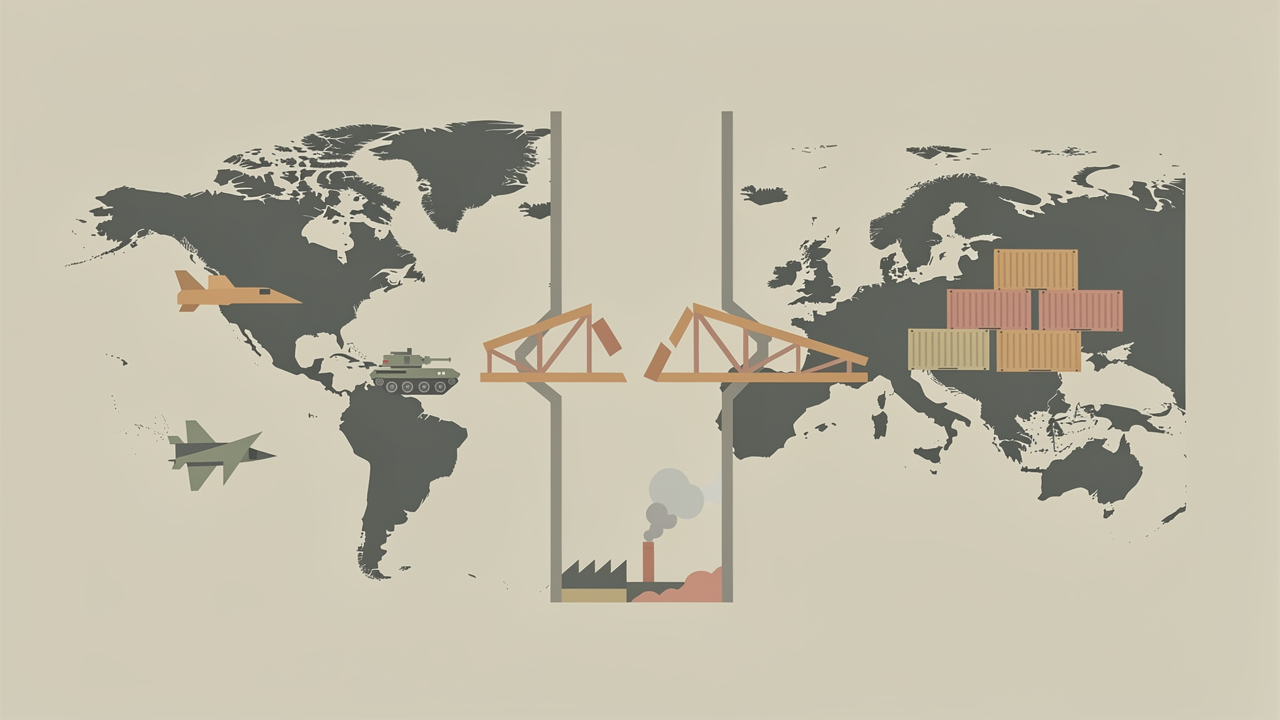
German Chancellor Friedrich Merz told the Bundestag this week that the United States is being “humiliated” by Iran, and that the conflict is hitting Germany’s export-dependent economy particularly hard. His broader argument was not just about trade: Merz said the Iran war shows Europe can no longer rely on Washington for strategic coherence, and called for a fundamental rethink of Europe’s relationship with its superpower ally.
The FT’s analysis of the transatlantic rift describes the two sides as locked in an unhappy marriage, held together by institutional inertia and the absence of an obvious alternative. That framing captures a paradox: the alliance is weaker than at any point in decades, yet neither side has a viable plan to leave. What has changed is that the shared strategic language that once papered over disagreements has largely dissolved.
The Iran war is the immediate source of tension, but the underlying structural problems have been visible for years. The United States has been shifting its strategic focus toward great-power competition with China. Europe, by contrast, faces a belt of instability on its southern and eastern flanks. The war in Ukraine remains the single largest security challenge on the continent, and European capitals have watched with alarm as the US has ramped up its military campaign against Tehran without consulting allies. The FT reports that European leaders are concerned about the human cost of the conflict and its broader destabilizing effects, including the risk of refugees and threats to Gulf shipping lanes.
One complication for the “Europe” that Merz speaks for is that it is not monolithic. NATO members have diverging views of the US retrenchment: Poland and the Baltic states still see Washington as their essential security guarantor against Russia, while Italy’s Giorgia Meloni and Hungary’s Viktor Orbán have aligned with the Trump administration on multiple fronts. The FT’s divorce analysis notes that the gap between these national positions has widened over time. The result is that Europe’s ability to present a united front to Washington is weaker than its aggregate economic weight would suggest.
European defense spending has also shifted. Most NATO members now meet the 2% of GDP target, and some are heading toward 3% or higher. That undercuts the old “free-riding” narrative that has long animated American frustration with Europe. But it has not resolved the deeper strategic mismatch: the US wants Europe to take more responsibility for its own neighborhood, while Europe wants the US to continue underwriting the broader global order that its trade-dependent economies rely on.
Into this atmosphere arrived King Charles and Queen Camilla, who began a state visit to the United States this week. The visit is a diplomatic balancing act: the British government wants to signal unity with Washington while using the royal family’s informal channels to convey European concerns about the Iran war. Britain occupies an awkward position as the European ally most tightly bound to the US intelligence and military apparatus, and the visit reflects an attempt to keep these ties functional even as the political relationship deteriorates.
Predictions of NATO’s death are nothing new. The alliance has weathered the Suez crisis, the Iraq war, and the missile deployments of the 1980s. What distinguishes the current moment is that the divergence of strategic interests has grown wider and more structural. The FT suggests the most likely outcome is not a formal divorce but a de facto separation: the US reduces its European military presence, Europe builds a defense identity that is functionally independent, and NATO survives as an administrative shell. Neither side publicly wants this, but both may be drifting toward it.
What happens next depends on whether European governments can translate their frustration into capability. Merz’s speech is a rhetorical marker, not a policy shift. The British state visit can buy time for diplomacy, but it cannot close the strategic gap. The question that remains is whether the alliance can be rebuilt on a basis that acknowledges the changed realities, or whether the drift will continue until the damage becomes self-reinforcing.
References
- Are Europe and America headed for divorce? — FT (accessed 2026-04-29)
- US being ‘humiliated’ by Iran, says German Chancellor Friedrich Merz — FT (accessed 2026-04-29)
- Britain’s King Charles and Queen Camilla arrive on state visit to the US — FT (accessed 2026-04-29)
Editor's notes — what this article still gets wrong
# Editor's notes
Where it lands
The piece is good on the structural argument: that the transatlantic gap predates the current Iran crisis and reflects genuinely diverging strategic geographies (US pivoting to China, Europe stuck with Ukraine and a turbulent south). The point that "Europe" is not monolithic, with Poland and the Baltics on one side and Meloni and Orbán on the other, is the kind of texture this story usually flattens.
Where it falls short
The sourcing is thin. Three FT articles is not enough load-bearing material for claims this sweeping, and several assertions (the "shared strategic language has largely dissolved," NATO surviving as "an administrative shell") are presented as analysis but are really just paraphrase of one FT op-ed. The defense spending paragraph also glosses over how recent and uneven the 2% compliance is, and how much of it is pledged rather than spent.
What it didn't answer
The obvious counter-argument goes unaddressed: that alliances routinely look terminal during specific crises and recover once the crisis passes. The piece asserts this time is different but does not seriously test that claim against the Suez and Iraq precedents it raises.