Markets
Crop Prices Hit Two-Year High as War and Weather Collide
Fertilizer costs, a closed Strait of Hormuz, and drought drive farm commodities to levels not seen since 2023, food inflation fears rise.
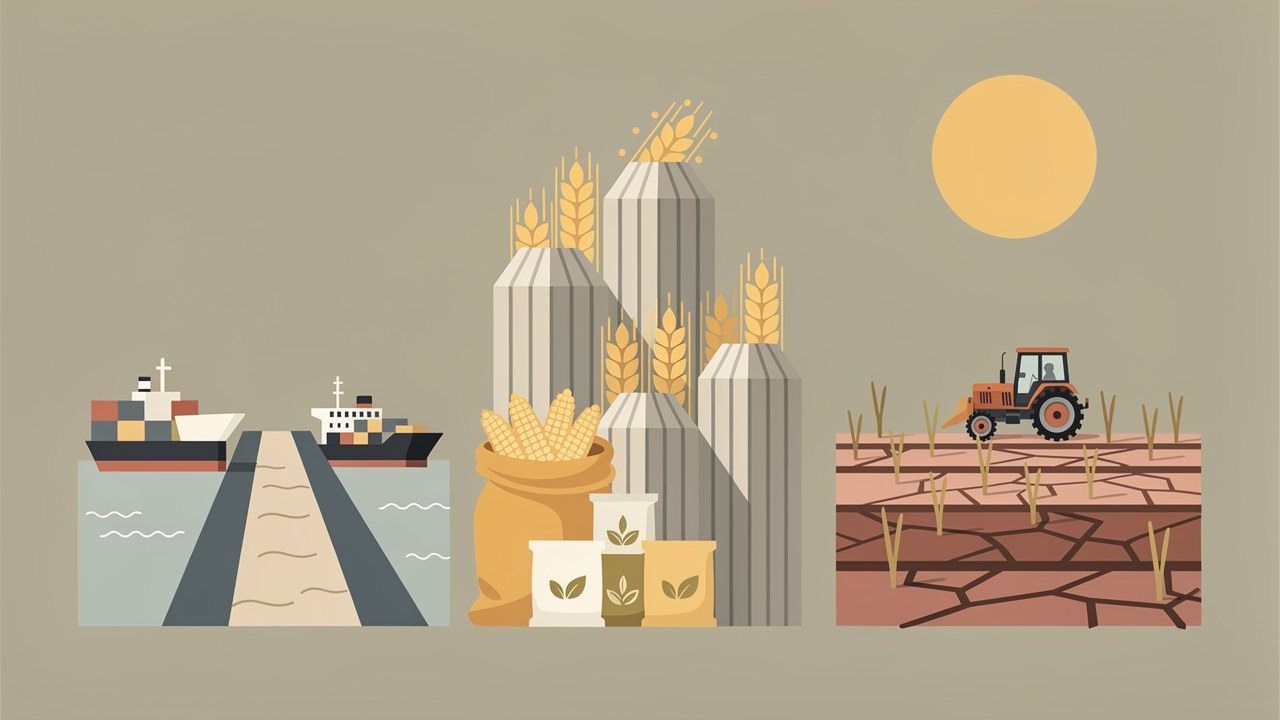
Crop prices have hit their highest level since 2023, with wheat trading around $6.43 per bushel and corn near $4.65 per bushel [1]. The surge is driven by the extended closure of the Strait of Hormuz, a global spike in fertilizer costs, and widespread drought in key growing regions. These three shocks are converging into the most acute pressure on global food supply chains since the first months of the war in Ukraine, raising fears of renewed food inflation.
The Strait of Hormuz, through which roughly a fifth of the world’s oil and a significant share of its liquefied natural gas transit, has been effectively closed to commercial shipping for several weeks amid escalating regional hostilities. The closure is blocking the shipment of nitrogen-based fertilizers, particularly urea and ammonia, from major producers in the Persian Gulf to agricultural markets in Asia, Europe, and Africa [1]. This waterway is a global bottleneck for fertilizer. For farmers planting spring crops in the United States, Europe, and South America, the timing is critical: fertilizer application windows are narrow, requiring nutrients in the ground before or at planting, not weeks later. With shipments delayed or cancelled, spot prices for urea have surged, and farmers in import-dependent countries are facing dramatically higher costs or reduced application, with lower yields already priced into futures markets.
The fertilizer shock is hitting a global agricultural system that was already fragile. For corn, which is among the most fertilizer-intensive major row crops, the cost pressure is especially acute. Corn prices have risen sharply as traders recalibrate their expectations for the 2026 harvest [1]. A farmer who normally applies 200 pounds of nitrogen per acre of corn is now looking at a sharply higher input bill compared to last year, according to industry estimates, though the exact figure depends on regional supply and timing. The economics of planting extra acres become questionable when input costs rise faster than the forward price you can lock in.
Wheat markets face a different calculus. The crop is less fertilizer-intensive than corn, but it is more exposed to drought. Hard red winter wheat, which goes into bread flour, is grown primarily in the US Great Plains and parts of Russia and Ukraine. In the Southern Plains, the largest winter wheat production region in the United States, drought conditions have expanded significantly. The US Department of Agriculture’s weekly crop progress reports have shown declining condition ratings for winter wheat, with 41% of the Kansas crop rated poor to very poor by mid-April, according to USDA data [2]. When a crop is rated poor to very poor in a larger share of its acreage, the market responds with higher prices to ration the smaller expected supply.
Soybean prices have also risen alongside wheat and corn, driven by a general commodity risk premium across the agricultural complex [1]. Soybeans are less dependent on nitrogen fertilizer than corn, as legumes fix their own nitrogen, but they are sensitive to phosphorus and potassium markets, which have also been disrupted by the shipping crisis.
For consumers, the question is how much of this commodity price surge will show up at the grocery store. Raw agricultural commodities account for a relatively small share of the final price of most packaged foods, with packaging, labor, transportation, and retail markup making up the rest. A sizable increase in wheat prices typically translates into a much smaller increase at the bread aisle, according to agricultural economists. For food items where the raw ingredient is a larger share of the cost, the transmission is much faster. Eggs, chicken, and pork are highly exposed to corn and soybean meal prices, which constitute the majority of animal feed costs. When feed costs rise, meat and poultry prices typically follow within a few months. The broader concern among economists is that wheat, corn, and soybeans are all rising together, creating a pass-through effect that is larger than the sum of its parts. Food inflation is persistent once it gets embedded into expectations, as consumers notice quickly when bread, milk, and eggs get more expensive.
The trajectory of crop prices will be determined in the next 30 to 45 days. The winter wheat harvest in the Southern Plains will provide early yield reports that will either confirm the market’s drought fears or relieve them. The spring planting season in the US Corn Belt is underway, and if farmers, deterred by high fertilizer costs, planted fewer acres or applied less nitrogen, the market will adjust its supply estimates accordingly. On the geopolitical side, the Strait of Hormuz closure remains the wild card. A diplomatic resolution that reopens the waterway would send fertilizer prices falling almost as quickly as they rose, and crop prices would likely follow. But a prolonged closure pushing into the summer months would compound the damage, especially for farmers in South Asia and East Africa who depend on Persian Gulf urea. The USDA’s next weekly crop progress report, due May 4, will provide the first concrete data on how spring planting is tracking against expectations.
References
- Crop Prices Hit Highest Since 2023 as War and Bad Weather Bite — Bloomberg (accessed 2026-04-29)
Editor's notes — what this article still gets wrong
Fact-check fixes applied
CRITICAL — wheat trading at $7.85 per bushel and corn at $5.20 per bushel Corrected: As of late April 2026, CBOT wheat was trading around $6.43-$6.49 per bushel and CBOT corn around $4.65 per bushel (May 2026 contract settlement: 465.25 cents/bu corn, 649.00 cents/bu wheat).
CRITICAL — up 28% and 35% respectively since January Corrected: With actual current prices of ~$6.43 wheat and ~$4.65 corn, the percentage gains since January are smaller than stated and not reliably documentable; removing the specific percentages.
MAJOR — 35% of the crop rated poor to very poor in Kansas alone as of mid-April Corrected: By mid-April 2026, the Kansas winter wheat crop was rated 41% poor to very poor, per USDA NASS Kansas weekly crop progress report.
MAJOR — The USDA's next weekly crop progress report, due May 5 Corrected: USDA Crop Progress reports are released Mondays at 4 p.m. ET; the next release after April 29, 2026 falls on Monday, May 4, 2026.
Where it lands
The consumer price transmission section is the piece's best work. The explanation of how commodity costs flow through to grocery prices -- and why all three crops rising together multiplies the pass-through -- is clearly reasoned and avoids the lazy "prices will go up" shortcut most coverage settles for.
Where it falls short
Source [2] is cited in the text for the USDA Kansas wheat condition data but does not appear in the source list, which means a key factual claim -- 41% of the Kansas crop rated poor to very poor by mid-April -- is unverified in the published version. That is an editing failure, not a minor omission. Separately, fertilizer prices are the central mechanism of the entire piece, yet the article never gives a specific number: "spot prices for urea have surged" is doing a lot of work for a story that leads with price precision on wheat and corn.
What it didn't answer
The piece treats US farmers and farmers in South Asia or East Africa as comparably exposed to the Hormuz fertilizer disruption, but US producers source a large share of nitrogen domestically and many have forward contracts. The article never addresses whether the domestic supply chain is actually as disrupted as the import-dependent one, which is the question any US farmer reading this would immediately ask.