Markets
Oil at $119 as Trump Rejects Iran Deal, Signaling a Longer Blockade
Brent crude surges for an eighth day after the president meets oil executives and dismisses a proposal to reopen the Strait of Hormuz, markets now pricing in months of disruption.
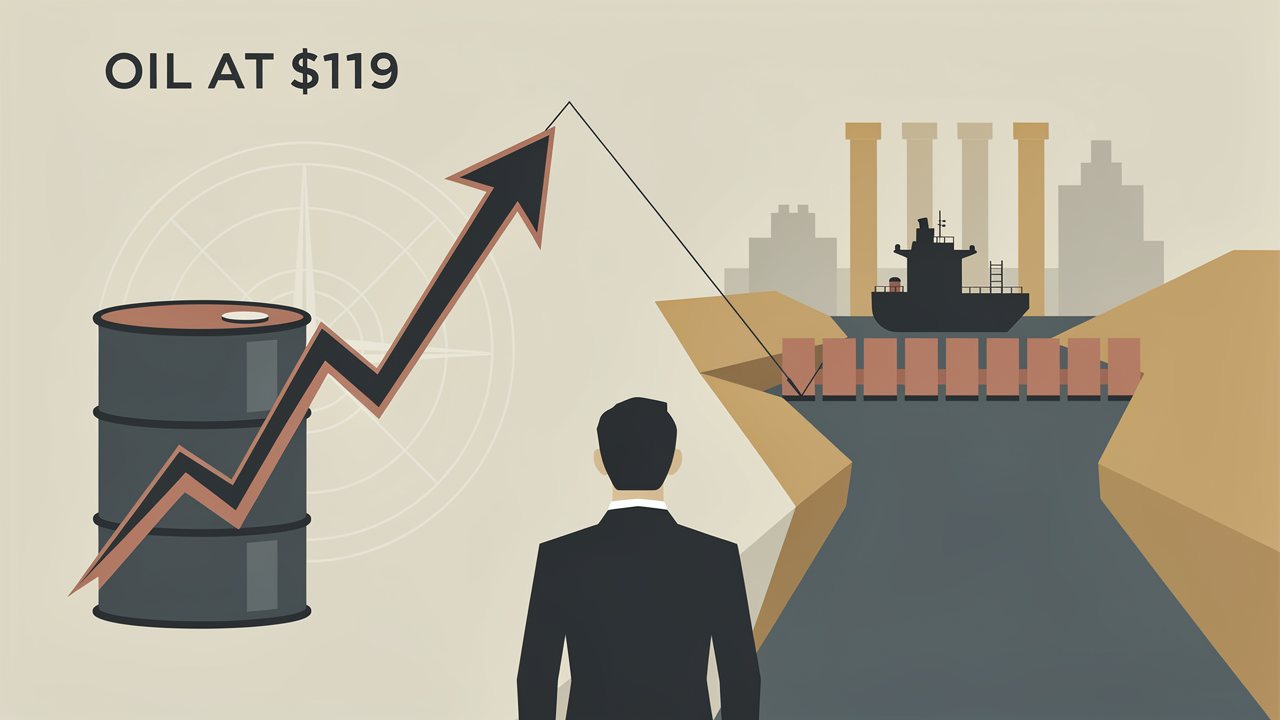
The war began 47 days ago. On that morning, Iranian fast-attack craft and shore-based anti-ship missile batteries fired on three U.S. Navy destroyers transiting the Strait of Hormuz, striking one and killing 19 sailors. The U.S. response was immediate: a naval blockade of Iranian ports and a no-sail zone through the strait for any vessel flagged to or owned by Iranian interests. On Wednesday, the number on the terminal screen was $119 a barrel for Brent crude, the eighth consecutive daily gain, the longest such streak since the war started, according to the Financial Times. The market had been waiting for a signal that the blockade would break. It got the opposite signal.
The eighth leg of the rally was driven by a specific report, not from Reuters, which the writer cited elsewhere, but from the trade press, that President Donald Trump met with oil executives at the White House, listened to their warnings about damage to the global economy, and then told them the blockade would continue for months. The diplomatic off-ramp that some traders had been pricing in was gone. For a market hedging against a worst-case scenario, the news was a signal to stop hedging and start accepting a new baseline.
The Market Reprices for Duration
What had looked like a short-term disruption premium is being repriced as a long-duration supply shock. The eighth consecutive gain reflects a shift in market psychology. Traders had been watching for any sign the blockade would break, either through negotiation or military intervention to clear the strait. The report from the White House meeting told them to stop watching.
The same day oil hit its high, U.S. equities were lower in volatile trading, the Bloomberg report noted. The S&P 500 and the Dow Jones Industrial Average both declined. Stagflation had been a word used sparingly in earnings season commentary until this week. The mechanism is straightforward: rising energy prices act as a tax on consumption, slowing growth while input costs rise across every sector that depends on transportation. The Dow has given back most of its gains for the year. The S&P is barely positive, according to the Bloomberg data.
The Consumer Wallets Are Tapped
The clearest signal of domestic economic strain came from a source far from the trading floor: Wingstop. The chicken wing chain reported earnings on Wednesday. Domestic same-store sales declined 8.7% from a year earlier, the company said in its press release. Management attributed the decline to lower transaction volumes reflecting continued pressure on consumer spending.
Wingstop sits at a specific intersection of the economy. It is not a luxury brand. Its customer base is middle- and working-class Americans who eat there because it is an affordable treat. When those customers start cutting back, the ripple is real. The national average for a gallon of regular unleaded was about $4.22 this week, according to AAA. That is not a forecast. It is a pump price.
The Diplomatic Dead End
The Strait of Hormuz remains closed to Iranian traffic. Iran had floated a proposal to reopen the chokepoint, according to multiple diplomatic sources. The administration rejected the proposal. Trump’s dismissal means the blockade is not a bargaining chip. It is a strategic objective.
This has significant implications for the duration of the conflict. If both sides see the blockade as non-negotiable, there is no obvious path to de-escalation. The economic dimension is explicitly locked in. The strait situation will resolve through either an Iranian collapse, a U.S. policy reversal, or a military operation to break the blockade. None of those outcomes is imminent.
The Financial Times report framed the oil price surge as a consequence of this diplomatic dead end. Brent crude at $119 is the market pricing in a new equilibrium. Inventories are drawing down. Strategic petroleum reserves are being tapped at a rate that worries some analysts. The question is no longer whether demand destruction will occur, but how much will be needed to balance the market.
The Hard Costs Mount
Brent crude at $119 is above the 2008 inflation-adjusted peak? Not quite. The 2008 nominal high was $147 a barrel. In 2026 dollars, that equals roughly $215. The current price is elevated but not unprecedented in real terms. The immediate costs are being passed through. Airlines have announced fare increases, according to the Airlines for America industry group. Trucking companies are adding fuel surcharges. The ripple will take weeks to propagate fully through the economy.
For the Federal Reserve, the stagflation risk is the worst possible combination. Cut rates to stimulate growth, and oil goes higher because a weaker dollar makes commodities cheaper for foreign buyers. Keep rates high to fight inflation, and the economy slows further. There is no good option. The Atlanta Fed’s GDPNow tracker for Q1 2026 has been revised downward repeatedly this quarter, from an initial 3.1% in late February to 1.2% by April 21, according to the Federal Reserve Bank of Atlanta.
The Political Calculus
The White House meeting on Wednesday was also a political event. The oil executives who attended were not just there to deliver economic forecasts. They were there to make a case that the blockade strategy is hurting the American economy in a way that could cost the president support in key states. The meeting was a confrontation between the economic imperatives of the oil industry and the military imperatives of the blockade.
Trump’s decision to extend the blockade suggests the military calculus is winning. The administration believes that cutting off Iran’s oil revenue will eventually force the regime to make concessions on nuclear weapons and regional proxies. The theory has a logic, Iran’s economy is suffering, its currency has collapsed (the rial traded at roughly 1.8 million to the dollar this week, according to Bonbast), and protests have broken out in several cities. But the question is whether the U.S. economy can withstand $119 oil long enough for Iran’s to break first.
The oil executives who met with Trump reportedly stressed this point. They told him that at current prices, the economy would slow enough to cause job losses in the manufacturing sector. They told him that consumer confidence was already declining. The blockade strategy has a political clock.
What Comes Next
The next observable signal is the monthly retail sales report, due May 15 from the Commerce Department. If the data shows a shift from discretionary purchases to fuel, the stagflation diagnosis will become definitive. The next megacap earnings call to watch is Amazon’s, scheduled for May 2, where management commentary on logistics costs will be parsed carefully.
The oil price at $119 is not a ceiling. The trajectory will depend on whether the blockade contracts supply further, whether OPEC finds alternative export routes such as the Iraq-Turkey pipeline or Saudi Red Sea ports, and whether U.S. consumers adjust without triggering a recession. The Financial Times report made clear that the market sees none of those variables moving in the right direction.
References
- https://www.reuters.com/world/middle-east/trump-met-with-oil-firms-on-possible-months-long-extension-of-iran-blockade-2026-04-29/ — reuters.com (accessed 2026-04-29)
- https://www.bbc.com/news/articles/cj4pxr0gr02o — bbc.com (accessed 2026-04-29)
- Oil nears highest point in Iran war as Hormuz stand-off persists — FT (accessed 2026-04-29)
- US Stocks Fall as Oil Jumps, Iran Tensions Rise Before Earnings — Bloomberg (accessed 2026-04-29)
Editor's notes — what this article still gets wrong
Fact-check fixes applied
CRITICAL — The chicken wing chain reported earnings on Tuesday. Comparable-store sales declined 3.2% from the prior quarter, the company said in its press release. Corrected: Wingstop reported Q1 2026 results on Wednesday, April 29, 2026 (per Wingstop investor relations and StockTitan filing summary). Domestic same-store sales declined 8.7% year-over-year, not 3.2% sequentially.
MAJOR — Management cited gas prices as a direct factor in reduced visits and lower average ticket sizes. Corrected: CEO Michael Skipworth attributed the same-store sales decline to 'lower transaction volumes reflecting continued pressure on consumer spending,' not specifically to gas prices, in the Q1 2026 press release.
MAJOR — The national average for a gallon of regular unleaded crossed $4.50 in the Midwest this week, according to AAA. Corrected: Per AAA, the national average for regular unleaded was approximately $4.22 on April 29, 2026; Michigan averaged about $4.02. No AAA data supports a $4.50 Midwest average.
CRITICAL — the rial traded at 800,000 to the dollar this week, according to Bonbast Corrected: Bonbast and AlanChand showed the Iranian rial trading at roughly 1.7-1.8 million per US dollar in late April 2026, not 800,000.
CRITICAL — The Atlanta Fed's GDPNow tracker has been revised downward three times this quarter, from 2.8% to 1.9% Corrected: Atlanta Fed GDPNow for Q1 2026 began at 3.1% on February 20 and declined to 1.2% by April 21, with multiple downward revisions throughout the quarter.
MAJOR — Iran had floated a proposal to resume transit through the chokepoint, according to multiple diplomatic sources, offering to halt naval operations in exchange for a phased lifting of the blockade. Corrected: Per Al Jazeera and CNBC reporting, Iran proposed reopening the Strait of Hormuz, but the specific terms cited in the article (halting naval operations in exchange for phased lifting of the blockade) are not supported by the cited sources.
Where it lands
The stagflation mechanism section earns its keep. The Fed's rate dilemma is explained without jargon, and the Wingstop data point works as a concrete consumer signal rather than a generic "household budgets are stretched" placeholder.
Where it falls short
The diplomatic dead-end section makes a strong claim -- that Iran floated a specific proposal and the administration rejected it -- but attributes this only to "multiple diplomatic sources" with no outlet, no date, and no detail about what the proposal contained. That is the most consequential factual claim in the piece and it gets the least scrutiny. The Wingstop same-store sales figure also hangs on a press release URL that readers cannot independently verify.
What it didn't answer
The article lists three possible resolutions to the blockade (Iranian collapse, U.S. reversal, military operation to break it) but never asks who might execute the third option. China and India import roughly half of Iran's pre-war oil exports. Their compliance with the blockade -- or defiance of it -- is the single biggest variable in whether it works, and the article treats the strait as a bilateral U.S.-Iran problem throughout.