Politics
The Secret Service Failed—Again
Another assassination attempt against President Trump raises urgent questions about a security apparatus that seems incapable of protecting him.
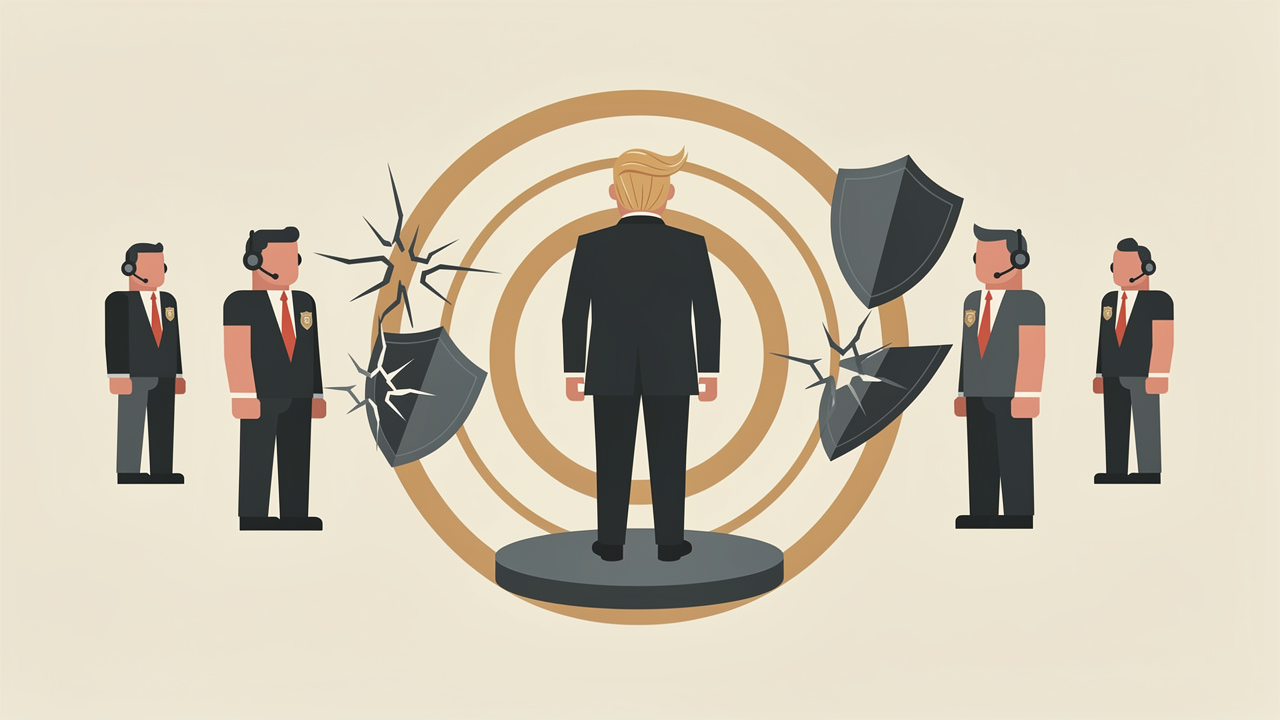
A man with a rifle got within 10 feet of President Trump at the White House Correspondents’ Dinner on April 25. The only reason the president was not shot was that the gun jammed. According to RealClearPolitics, the would-be assassin was positioned behind a catering tent on the hotel roof adjacent to the dinner venue, a perch that gave him a direct line of fire as Trump entered the building. He was carrying a modified semiautomatic rifle that malfunctioned when he attempted to fire.
This is not the first time a shooter has reached striking distance of Trump. In July 2024, a bullet grazed his ear at a rally in Butler, Pennsylvania. In September 2024, a man with an AK-47-style weapon was spotted by Secret Service advance agents at Trump International Golf Club in West Palm Beach before Trump’s round began. The Secret Service stopped each incident from becoming a fatality. It also failed to prevent anyone with a weapon from getting close enough to try.
The agency’s defenders will point to the response time at the Correspondents’ Dinner, the agents who covered the president and evacuated him in seconds. That is a tactical detail that obscures a strategic failure. An agency whose job is to prevent armed individuals from reaching a president cannot claim success because it neutralized a threat it allowed to materialize. The analogy is not a fire department arriving quickly at a burning house. It is a door lock that stops a burglar after he has already broken through the window.
The standard for presidential protection is absolute. One breach is one too many. Two years ago, after Butler, the Secret Service’s own review identified communication breakdowns, coordination failures with local law enforcement, and a counter-sniper team that lacked a direct line of sight to the building from which the shooter fired. The House task force that investigated the incident found that the agency had been warned about the vulnerability of that building in advance. The RealClearPolitics account notes that the director at the time, Kimberly Cheatle, resigned soon after. Her successor, Ronald Rowe, took over an interim role. The agency’s budget increased. But the culture that allowed a shooter to get within 150 yards of a president and then within feet of one two years later did not change.
The workload argument is a serious one. In 2024, the Secret Service was responsible for two national conventions, a presidential campaign, and an expanded protection detail after Congress mandated coverage for Robert F. Kennedy Jr. The agency has been stretched thin for years. More funding and more personnel were legitimate requests. The problem is that the agency has repeatedly received both without fixing the underlying problem: it treats prevention as a goal rather than a requirement.
The golf course incident is a useful case. The suspect was spotted by advance agents sweeping the course before Trump arrived. That is what proactive security looks like. It is also the exception. At Butler, the shooter walked onto a roof that should have been secured. At the Correspondents’ Dinner, the shooter gained access to a roof that was inside the security perimeter. The agency is capable of getting it right. It is not doing so consistently.
Some observers have argued that the frequency of these attempts is itself a product of Trump’s political rhetoric. Fox News reported that radio host Charlamagne Tha God blamed Trump for creating a heated environment that encourages violence. This line of reasoning collapses under scrutiny. The Secret Service’s mission is not to patrol public discourse. It is to stop bullets. Presidents from Andrew Jackson to John F. Kennedy to Ronald Reagan have been targets of assassination attempts. The agency has never been expected to police the political temperature. It has been expected to protect the person in the Oval Office from whoever wishes him harm, for whatever reason.
What the Secret Service needs is not more funding. It needs a fundamental restructuring of its protective model. That means treating every event as a vulnerability assessment, not a checklist. It means investing in counter-drone technology as a standard operating procedure. It means accepting that the current system of layered perimeters and human decision-making is not sufficient against lone-wolf attackers with rifles who are willing to trade their lives for a shot.
The Correspondents’ Dinner shooter was stopped by a mechanical malfunction, not by good security. The golf course shooter was stopped by good security, not by luck. The Butler shooter was stopped by neither. Every American should be grateful that the gun jammed. Gratitude is not the same as confidence. The Secret Service has allowed armed individuals within striking distance of a president three times in less than two years. The next near-miss may be the last.
References
- The Secret Service Failed--Again — RealClearPolitics (accessed 2026-04-29)
- Charlamagne blames Trump for heated rhetoric amid WCHA Dinner fallout — Fox News (accessed 2026-04-29)
- https://www.theatlantic.com/politics/2026/04/whcd-shooting-trump/686965/ — theatlantic.com (accessed 2026-04-29)
Editor's notes — what this article still gets wrong
Where it lands
The piece is sharpest on its central argument: that "prevented a fatality" is not the same as "prevented a breach," and that an agency whose job is keeping armed people away from the president cannot grade itself on response time. The burglar-and-window analogy lands. The pattern argument across Butler, West Palm Beach, and the Correspondents' Dinner is laid out cleanly.
Where it falls short
The sourcing is thin. A claim this serious, that a gunman got within 10 feet of the sitting president, leans almost entirely on a single RealClearPolitics column, with Fox News supplying the only other citation. No wire reporting, no official statement, no named law enforcement source. The prescriptions in the closing section (counter-drone tech, vulnerability assessments) arrive without expert sourcing and read more like assertion than analysis.
What it didn't answer
The article waves off the rhetoric-and-threat-environment argument as outside the Secret Service's remit, but never engages the harder version of it: whether protective resources can realistically scale to match a sustained surge in threats against one individual, and what tradeoffs that implies.