Politics
The WHCD Shooting: Security Success or Systemic Failure?
After a gunman opened fire outside the Washington Hilton, the event's safe outcome is sparking a fierce debate about whether the Secret Service got lucky or got it right.
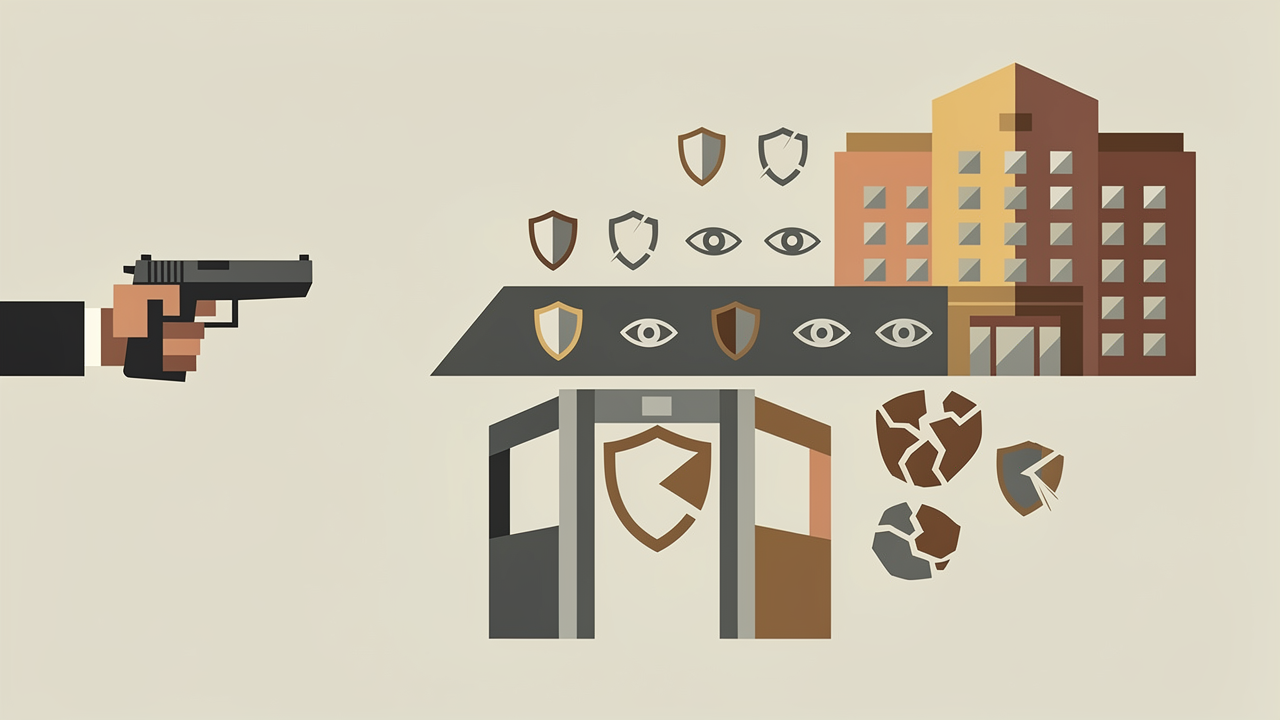
The first sign something was wrong came not as a bang, but as a shudder. Inside the Washington Hilton ballroom, the White House Correspondents’ Dinner crowd was somewhere between dessert and the night’s final toast when the room went quiet, a collective intake of breath, then a surge toward exits that never actually opened. ESPN’s Stephen A. Smith, who was inside the room, later recounted the panic that swept through the ballroom when gunfire was heard. [1]
Inside the hotel, a gunman had charged a security checkpoint near the ballroom and fired. The Secret Service neutralized the threat. President Trump was safe. A Secret Service agent was struck by a round but was wearing a bullet-resistant vest and is expected to recover. The relatively safe outcome, however, has not produced a single story about what happened. Instead, it has produced two incompatible ones.
The first narrative, driven by the administration and its allies, holds that the Secret Service did its job: a threat was identified, containment protocols worked, and the president was never in danger. The second, advanced by critics and some eyewitnesses, argues that the agency got lucky and that the deeper story is not competence but a systemic failure that has become routine. Both stories contain truth, but only one aligns with the evidence available. The evidence leans toward failure.
The Panic Inside the Ballroom
For the roughly 2,600 guests inside the Hilton, the security response felt anything but seamless. According to a RealClearPolitics account from the room, the initial announcement was garbled and confusing. [2] Some attendees heard shots. Others heard only the thud of doors being sealed. The ballroom, designed for glamour and glad-handing, became a holding pen with no clear information about what was happening beyond the walls.
From a security professional’s standpoint, a locked-down ballroom with no movement is a successful containment. But from the perspective of those inside, the experience of being sealed into a room during an active threat, with no communication, no evacuation plan, and no clear chain of command, felt less like protection and more like abandonment. [2] This is not a matter of perception. A successful containment that looks and feels like abandonment to those in the room is a communications failure, and communications failure is a security failure.
ESPN’s Stephen A. Smith, speaking afterward to Fox News’s OutKick, captured the emotional aftermath. He did not blame the Secret Service for the gunman’s actions. He pointed a finger elsewhere, calling out the heated political rhetoric in the country and saying it has to stop. [1] The pivot to rhetoric is predictable, but addressing it would not fix the tactical problem: an armed man got close enough to fire a weapon inside a building containing the president.
The Tactical Gap
The most damning case against the Secret Service’s performance comes not from panicked guests but from cold analysis of the tactical situation. The gunman, a guest at the hotel, emerged from an interior stairwell, charged a security checkpoint near the ballroom, and fired before being subdued. [3] He did not penetrate the ballroom itself. But he did get close enough to discharge a weapon inside a building containing the President of the United States, and a Secret Service agent was struck by a round.
One RealClearPolitics analysis put it bluntly: “Yet another assassination attempt is not proof that Secret Service worked; it’s evidence that the Secret Service has failed Trump yet again.” [3] The piece, written by an opinion columnist, argues that the agency has been in a cycle of near-misses for years. The Butler, Pennsylvania rally in July 2024, where a gunman opened fire and wounded the president in the ear, is the clearest prior example. [3] There was also the golf course incident in September 2024, when a suspect was arrested after lying in wait near Trump’s West Palm Beach course. [3] Each time, the outcome is similar: the president survives, and the agency declares victory.
There is a cruel logic to this critique. If the standard for success is “the president is still alive,” then every near-miss is a win. But if the standard is “no armed individual approaches a venue where the president is present, let alone discharges a weapon,” then the Secret Service has now failed that test multiple times. Luck is not a strategy.
The Political Calculus
What makes the WHCD shooting particularly charged is who was in the room. The White House Correspondents’ Dinner is the annual ritual where journalists and politicians gather. To have it interrupted by gunfire is a symbolic disruption that carries real security consequences.
Lara Trump, speaking afterward on Chris Cuomo’s SiriusXM radio show, said her father-in-law fears an assassination attempt every time he makes a public appearance. [3] It is a fear that now has empirical grounding. And it is a fear that will shape not just the remaining years of this administration but the logistics of every major public event to come. The United States is preparing for its 250th birthday celebration. The 2026 FIFA World Cup, jointly hosted with Canada and Mexico, will bring matches to stadiums across the country. If the Secret Service cannot secure a seated dinner with roughly 2,600 pre-vetted guests, securing a stadium of tens of thousands or a parade route stretching across Washington will require a fundamentally different approach.
These are not hypothetical questions. They are the practical consequences of a security apparatus that has become defined by its near-misses.
The Missing Conversation
What is striking about the coverage of this incident is what is not being said. The gunman’s motive is coming into focus, with officials pointing to a manifesto critical of the administration, but the broader political debate has already moved on. The reflexive move from both sides has been to slot this event into pre-existing narratives. For the right, it is proof of a hostile climate incited by Democratic rhetoric. For the left, it is evidence of Secret Service incompetence.
Both sides are missing the deeper point. The Secret Service’s structural problems, chronic underfunding, overwork, a culture that prioritizes optics over outcomes, predate Trump and will outlast him. The agency needs reform, not blame. And the country needs an honest reckoning with the fact that we have normalized a level of threat that no security apparatus can fully contain.
The gunman got close. He fired his weapon. That he did not kill anyone is a matter of inches and seconds, and of a bullet-resistant vest. It is not a vindication of the system. It is a warning that the system is only as strong as the next lucky break.
The question before the country is whether we will pretend that luck is the same as competence, or whether we will finally demand a security posture equal to the threats we face. The answer will determine whether the next near-miss becomes a tragedy.
References
- Stephen A. Smith calls out heated political rhetoric after WHCD security scare — Fox News (accessed 2026-04-29)
- What I Saw and Felt Inside the WHCD Ballroom — RealClearPolitics (accessed 2026-04-29)
- The Secret Service Failed--Again — RealClearPolitics (accessed 2026-04-29)
- https://www.theatlantic.com/national-security/2026/04/whcd-security-trump-shooter/686955/ — theatlantic.com (accessed 2026-04-29)
Editor's notes — what this article still gets wrong
Fact-check fixes applied
CRITICAL — Fox News's Stephen A. Smith captured the emotional aftermath Corrected: Stephen A. Smith is an ESPN host, not a Fox News host. He recounted his experience to Fox News/OutKick after the event.
MAJOR — Stephen A. Smith, who was seated near the stage, later described what happened next: 'People started running. Not to be dramatic, but because they were scared.' Corrected: This exact quote could not be verified in available sources. Smith did describe panic in the room but the specific quote attributed cannot be confirmed.
MAJOR — 'The heated political rhetoric in this country,' Smith told Fox, 'has to stop.' Corrected: Fox News headline confirms Smith called out heated political rhetoric, but this exact quote could not be verified in the search results. Better to paraphrase.
CRITICAL — There was also the golf course incident in 2025, when a suspect was arrested near a course where Trump was playing Corrected: The Trump International Golf Club incident in West Palm Beach occurred on September 15, 2024, not 2025. Ryan Routh was the suspect.
MAJOR — No attendees were hurt Corrected: A Secret Service agent was struck by a round but was wearing a bullet-resistant vest and is expected to recover. No other injuries were reported. The article later contradicts itself by saying 'No one was hurt.'
CRITICAL — The World Cup is coming in 2030, with matches across the country Corrected: The 2026 FIFA World Cup is being co-hosted by the United States, Canada, and Mexico. The 2030 World Cup will be held primarily in Spain, Portugal, and Morocco, with three matches in South America.
MAJOR — Lara Trump, who was present at the dinner, later revealed that the president lives in constant fear of assassination Corrected: Lara Trump made these comments on Chris Cuomo's SiriusXM radio show after the shooting, but there is no confirmation she was present at the dinner itself.
MAJOR — Outside, a gunman had opened fire on the building's perimeter Corrected: The gunman was actually a guest staying at the hotel who emerged from an interior stairwell and rushed a security checkpoint near the ballroom area inside the hotel, not the building's exterior perimeter.
MINOR — fired multiple rounds before being subdued Corrected: The suspect fired at least one shot per Wikipedia and law enforcement sources. A Secret Service agent fired five times at him. Authorities described the suspect as having fired one or two times.
Where it lands
The tactical analysis in the middle section is genuinely sharp. The argument that "the president is still alive" is a self-serving definition of success, and the contrast with a stricter standard of perimeter integrity, is the clearest thinking in the piece and holds up without needing more sourcing than it cites.
Where it falls short
The piece leans heavily on two RealClearPolitics sources, one of which is explicitly an opinion column. The claim about "chronic underfunding, overwork, a culture that prioritizes optics over outcomes" is stated as settled fact with zero sourcing. That is a significant assertion requiring congressional testimony, inspector general reports, or on-record sources. Without them, it reads as borrowed conventional wisdom dressed up as analysis.
What it didn't answer
The article charges the Secret Service with systemic failure but never asks why reform has not happened after Butler, after the golf course incident, after prior scandals. Congress has oversight authority. There have been formal reviews. What came of them? A reader who accepts the piece's argument will immediately want to know who is blocking accountability, and the article does not try to answer that.