Markets
Oil's $126-to-Tumble Day: The Iran Shock Is Reshaping Every Market Bet
Brent crude hit a four-year high on Strait of Hormuz fears, then collapsed in the most volatile session in years, and central banks are now caught in the crossfire.
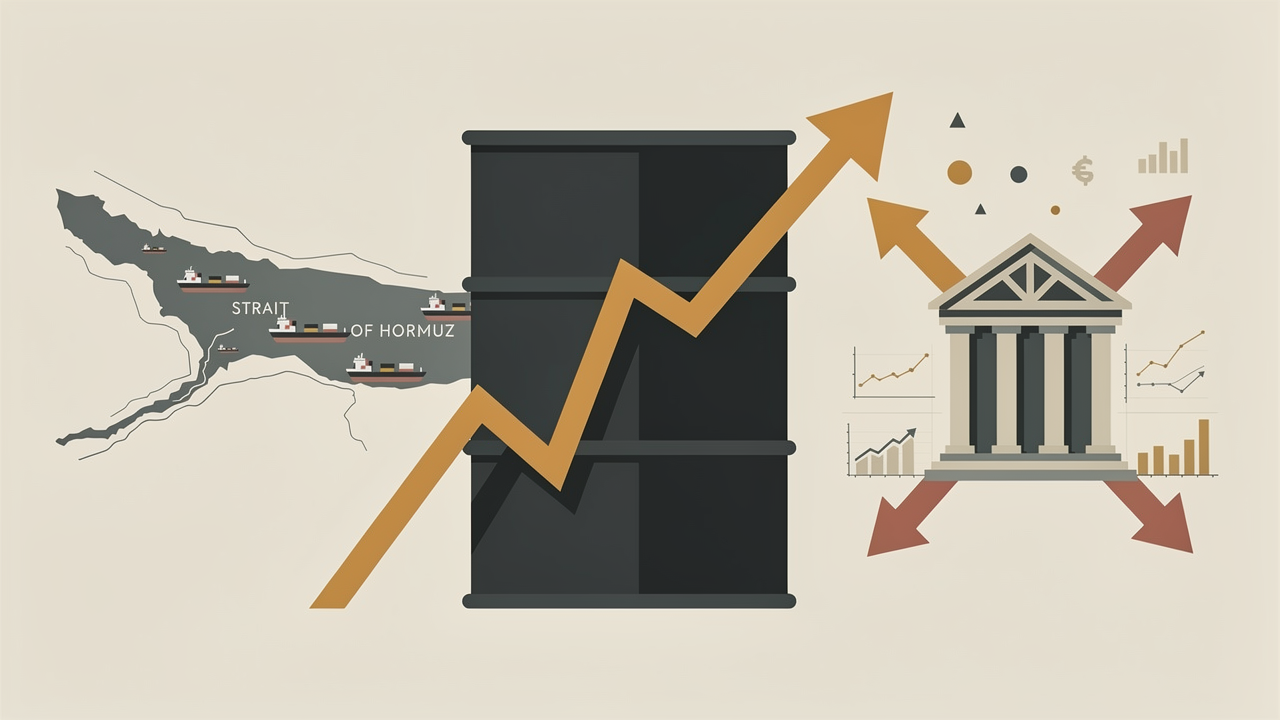
Brent crude touched $126.41 a barrel by mid-morning in London, the highest level since Russia’s invasion of Ukraine in 2022. The trigger was an Axios report that US Central Command had prepared military strike options against Iran, escalating the confrontation over a Strait of Hormuz blockade that Iran’s new Supreme Leader, Mojtaba Khamenei, had threatened to enforce. Then the slide began. By the close, Brent had fallen back below $120, leaving a candlestick pattern that looked like the market had briefly lost its mind.
The session was the most volatile in oil markets in years, according to the Financial Times. It was not an isolated event. The price action reflected a genuine supply threat in the Persian Gulf, a central banking establishment caught between inflation and recession, and a bond market that no longer trusts forward guidance.
The mechanics of a $126 spike
The oil move was not about physical barrels changing hands. It was about options markets repricing a tail risk that suddenly felt less remote. A full Strait of Hormuz blockade would remove roughly 20 million barrels per day of crude oil and petroleum products from global supply, according to the US Energy Information Administration. Even a credible threat of such a closure forces every refiner and trading desk to pay for protection. The spike to $126 was the protection cost spiking as the CENTCOM report landed on screens.
What made the subsequent collapse notable was that the retracement did not come from de-escalation. There was no diplomatic breakthrough. The price fell because traders who had bought the spike realized there was no follow-through buying, and because the same algorithmic strategies that had driven the surge began selling into it. The Financial Times described “wildly volatile trading” as Brent crude hit a new conflict high before dropping back. The session was a warning: markets are now so sensitive to headlines that a single report can produce a 5% intraday swing, but the underlying trend remains driven by the blockade itself, which is ongoing.
The blockade threat is real. Mojtaba Khamenei, who succeeded his father Ali Khamenei as Supreme Leader, has positioned himself as a hardliner on confrontation with the West. His statements about closing the Strait in response to sanctions enforcement have been taken seriously by shipping insurers and tanker operators. Several carriers have already idled Gulf routes. The risk premium embedded in crude prices now reflects not just the chance of a conflict but the cost of rerouting global supply chains around Africa, a journey that adds two weeks to transit times and sharply increases freight costs.
Baseline matters. Before the session, Brent was trading around $115 a barrel, up from roughly $61 at the start of the year. The spike-and-collapse pattern on that day suggests that traders are treating the blockade as a binary event that will be resolved quickly. But the continuing disruption to shipping, the hardline posture of the new Iranian leadership, and the CENTCOM planning that was reported all point to a situation that could persist for months. If the blockade continues, the current risk premium in oil will look like a discount.
OPEC+ is a wild card. Saudi Arabia has historically released spare capacity at prices above $100, and the kingdom currently holds roughly 2 to 3 million barrels per day of idle supply. Whether OPEC+ acts depends on whether it views the spike as a demand or supply phenomenon. A supply disruption in the Gulf affects Saudi exports directly, making the calculus more complex than a simple decision to pump more.
Central banks caught in the crossfire
The oil spike landed directly on top of a week of central bank decisions. The ECB held rates at 2% but warned that risks to the economy from the energy shock driven by the Middle East conflict had “intensified.” The Bank of England held at 3.75%, saying it was “ready to act” if needed. Its Monetary Policy Committee explicitly noted that borrowing costs may need to rise if the energy shock continues. The Federal Reserve also held, with chair Jerome Powell confirming he will step down as chair next month while remaining on the Board of Governors, as bond investors brace for what they described as a likely “volatile” transition to incoming chair Kevin Warsh.
All three central banks face the same dilemma. An energy supply shock is inflationary: higher oil prices feed directly into gasoline, heating oil, jet fuel, and the cost of every good transported by truck or ship. But it is also recessionary: it acts like a tax on consumers and businesses, reducing spending power at the same time that borrowing costs are already elevated. The conflict is structural: if the Strait of Hormuz remains disrupted for months, the pass-through to core inflation will be larger than most models assume. Energy costs feed into industrial production, transport, and food prices with a lag. The ECB’s warning that risks have “intensified” signals the bank is preparing for a scenario in which it has to raise rates into a slowdown. The Bank of England’s “ready to act” formulation is the same message in blunter terms.
The yen, the bond market, and the repricing
The oil volatility rippled immediately into currencies and bonds. The yen spiked against the dollar, triggering speculation that the Bank of Japan had intervened to support its currency. A stronger yen compounds the energy shock for Japan, which imports nearly all its crude. The BoJ has been reluctant to raise rates at home, but a rising oil price and a falling yen are a dangerous combination for an import-dependent economy.
In Treasuries, the day’s events produced a rebound as Brent retreated, with US bonds gaining on the oil price decline. But yields stayed near their recent peaks, a sign that “simmering inflation fears” are not going away. The bond market is pricing in a future in which central banks cannot cut rates as much as they would like, because inflation will remain sticky even as growth slows.
The bond market is also watching the Fed transition with unease. Warsh is set to take over as chair at a time of “deep division” among fund managers about the path of policy, according to the Financial Times. Investors are bracing for a period in which the Fed may need to signal rate hikes even as the economy weakens. The oil spike makes that scenario more likely. As one bond investor told the FT, the transition “could get very messy very quickly if oil stays elevated.”
The growth backdrop
The oil spike lands on an economy that is already slowing. The US economy grew at a 2% annualized rate in the first quarter, undershooting the 2.3% Bloomberg economist survey forecast and representing a pickup from a weak end to last year but hardly strong growth. That 2% is below trend, and it was achieved before the full impact of the oil disruption was felt.
The combination of slowing growth and rising energy inflation is the stagflation trade, the dominant narrative in fixed income. Equities have held up better than bonds, but the volatility in oil is a leading indicator of volatility in stocks. If oil stays above $100 for an extended period, corporate margins will compress and consumer spending will weaken. The central banks that held rates this week will face pressure to act, either by raising rates to fight inflation or by cutting them to support growth. They cannot do both.
What to watch next
The most likely near-term outcome is continued volatility. Oil will trade in a wide range, testing the $120 level on any escalation news and falling back on any sign of diplomacy. The central banks will maintain their hawkish posture but will be reluctant to act preemptively, hoping the supply shock resolves on its own.
Three concrete triggers to monitor. First, confirmation from CENTCOM or the Pentagon on the status of the reported strike options. Second, Bank of Japan intervention data released at the end of the month, which will settle whether the yen spike was intervention or positioning. Third, whether the ECB calls an emergency meeting before its June decision. Each of these events would tell traders whether the $126-to-tumble day was a one-off volatility event or the preview of a deeper structural shift in global markets.
References
- Oil tumbles after surging to $126 on supply fears — FT (accessed 2026-04-30)
- https://www.bbc.com/news/articles/cx21m88rd14o — bbc.com (accessed 2026-04-30)
- https://www.reuters.com/article/iran-threatens-painful-response-if-us-resumes-attacks-oil-prices-seesaw-idCN — reuters.com (accessed 2026-04-30)
- US Treasuries Rebound Post-Fed as Oil Eases From Four-Year Highs — Bloomberg (accessed 2026-04-30)
- Bond investors brace for ‘volatile’ Fed transition as Powell stays on — FT (accessed 2026-04-30)
- ECB holds interest rates at 2% as inflation rises — FT (accessed 2026-04-30)
- Bank of England holds rates at 3.75% but says ‘ready to act’ if needed — FT (accessed 2026-04-30)
- https://www.reuters.com/article/iran-supreme-leader-mojtaba-khamenei-says-new-management-of-strait-of-hormuz-will-bring-calm-idCN — reuters.com (accessed 2026-04-30)
- https://www.bloomberg.com/news/articles/2026-04-30/yen-jump-spurs-speculation-of-intervention-after-final-warning — bloomberg.com (accessed 2026-04-30)
- https://apnews.com/article/oil-prices-whipsaw-stocks-near-record-highs — apnews.com (accessed 2026-04-30)
- US economy undershot expectations to grow at 2% rate in first quarter — FT (accessed 2026-04-30)
Editor's notes — what this article still gets wrong
Fact-check fixes applied
MINOR — Brent crude touched $126.47 a barrel by mid-morning in London Corrected: Brent's intraday high was $126.41, not $126.47, per CNBC and other reporting on April 30, 2026.
MAJOR — A full Strait of Hormuz blockade would remove roughly 20 million barrels per day of crude from global supply, according to the US Energy Information Administration. Corrected: The EIA's ~20 mb/d figure for Hormuz flows includes both crude and petroleum products. Crude alone is closer to 15 mb/d. The article overstates the crude-only volume.
CRITICAL — Before the session, Brent was trading around $115 a barrel, up from $90 at the start of the year. Corrected: Brent opened 2026 at roughly $61/barrel (EIA: $61.03 on Jan 2, 2026), not $90. The pre-session level around $115-118 is roughly correct.
CRITICAL — Powell takes over at a time of 'deep division' among fund managers about the path of policy Corrected: Powell is stepping down as Fed chair next month; Kevin Warsh is the incoming chair, while Powell stays on the Board of Governors. The article's framing reverses the direction of the transition.
MINOR — undershooting the 2.2% Bloomberg economist survey forecast Corrected: The consensus economist forecast for Q1 2026 advance GDP was approximately 2.3%, not 2.2% (per InvestingLive and other reporting on the BEA release).
MINOR — the kingdom currently holds roughly 3 million barrels per day of idle supply Corrected: EIA and industry estimates put Saudi spare capacity in the 2-3 mb/d range as of 2026; 'roughly 3 million' is at the high end but defensible.
Where it lands
The mechanics section is the best work in the piece. Explaining the spike as options markets repricing tail risk rather than physical barrels changing hands is precise and non-obvious, and the algorithmic-selling explanation for the retracement is correct and clearly stated. That's real financial reporting.
Where it falls short
The "blockade threat is real" paragraph makes three specific empirical claims -- carriers idling Gulf routes, a two-week rerouting add, freight cost impacts -- with zero sourcing attached. The piece cites the FT and Bloomberg throughout, but here it speaks with full confidence and no citation. That asymmetry undermines the strongest factual section. The OPEC+ spare-capacity figure (2-3 million bpd) has the same problem.
What it didn't answer
The article treats the Axios CENTCOM report as a neutral market catalyst and moves on. It never asks whether the leak was deliberate -- a signal sent to Tehran, or a trial balloon from within the defense establishment. In a story about a market that moved 5% on a single report, the provenance and intent of that report is the most important unanswered question.